Raqchi
RAQCHI Continuando la ruta hacia el este de la ciudad de Puno, en el Km. 125 está el pueblo de Raqchi que pertenece al distrito de San Pedro de Cacha, provincia de Canchis. Raqchi se encuentra en el banco correcto del río de Vilcanota, a una altitud de 3500 mts. (11500 pies). Al parecer su nombre prehispánico era "Cacha" y no "Raqchi".
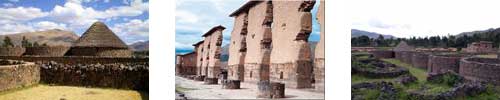
Las evidencias indican que Raqchi era un pueblo complejo de construcciones múltiples, incluso las terrazas del cultivo para diversos propósitos, "kanchas" (apartamentos), "wayranas" (edificios que tienen sólo 3 paredes), "qolqas" (almacenes), diferentes urnas, las fuentes de agua religiosas, etc. Posiblemente, era un "tambo" importante en la ruta hacia el "Collasuyo". El edificio más importante dentro del complejo es el "Templo de Wiraqocha", que según los cronistas antiguos fue construido por el Inca Wiraqocha en homenaje al Dios Superior invisible de las personas andinas: "Apu Kon Titi Wiraqocha". Pedro Cieza de Léon coleccionó la tradición que dice que la urna se construyó después de la apariencia de un hombre que empezó realizando milagros en este lugar, y los habitantes del pueblo habían decidido apedrearlo a muerte; pero al ir en busca de ese hombre extraño lo encontraron arrodillado con los brazos extendidos e inmediatamente después cayó una lluvia de fuego. Así, esos hombres arrepentidos lo dejaron libre; ese hombre extraño se había ido hacia la costa y se sumergió en las aguas del océano y desapareció para siempre. Después de esto se construyó una urna en su memoria y una escultura de un ídolo de piedra que según algunos conquistadores que lo vieron, había sido la imagen de algún apóstol cristiano que pasó por estas tierras. Involucrando a la lluvia de fuego, es posible que se refirieron alguna erupción del volcán "Kinsach'ata" actualmente extinguido que se localizó por los esos ambientes; alrededor de la zona hay una gran cantidad de lava seca (piedra volcánica). El "Templo de Wiraqocha" es una construcción grandiosa para su era. Arquitectónicamente es clasificado como "kallanka"; es decir, un edificio grande cubierto completamente con paja (madera e "ichu"); exteriormente mide 92 m. (302 pies) largo y 25.25 m. (83 pies) de ancho. Su pared central se fabricó con piedras finamente talladas la base tiene una altura aproximadamente de 3 m. de adobe (ladrillos de tierra con paja secados por el sol) las paredes tienen 1.65 m. de espesor por la base y 1.30 m. aproximadamente por la parte superior. Hoy esa pared tiene 12 m. de altura y hace un siglo, tenía 15 m. y según una reconstrucción hipotética hecha originalmente por Santiago Agurto debe de haber tenido 16.60 m. Sus paredes laterales tenían 1.20 m. de espesor y 3 m. de altura.
El techado era impresionante con casi 2500 m² y una inclinación de cuesta aproximadamente de 50°. Había columnas redondas que todavía se encuentran en las bases entre la pared central y el lateral para apoyar el tejado; esas columnas tenían 1.60 m. de diámetro y aproximadamente 9.80 m. de altura. Hay algunos otros sectores muy importantes con los restos de "wayranas" y una gran cantidad de "qolqas" con paredes de tipo "pirka" en este mismo sitio.
Sitios Arqueológicos de Cusco |
Chinchero - Salinera de Maras - Moray - Tipón - Pikillacta - Raqchi |